
Your Cart is Empty
$50 OFF ORDERS OF $450 OR MORE -- CODE: 50OFF450
$50 OFF ORDERS OF $450 OR MORE -- CODE: 50OFF450


MK8 GTI & Golf R / Gen 4 EA888
The MK8 Gen 4 EA888 is a more capable platform than the MK7 right out of the box. But heat is still the ceiling. Here is how to raise it.
Quick Answer
For most MK8 GTI and Golf R builds running the stock Continental turbo at Stage 1 or Stage 2 power levels, the ARM MK8 FMIC Kit is the right choice. It positions the intercooler in front of the radiator stack for maximum cooling efficiency, dramatically reduces intake air temperatures, and installs 100% bolt-on with no cutting or drilling. The ARM MK8 Bi-Cooler Upgrade is designed for MK8 builds running an upgraded turbocharger, where a higher thermal load requires the combined cooling capacity of the ARM FMIC and the stock-location intercooler running in series simultaneously.

The MK8 Golf R and GTI are different machines than the MK7. The Gen 4 EA888 brought a new Continental turbocharger with a larger compressor wheel, a smaller turbine wheel, and RAAX geometry that lets it spool faster while still flowing well at the top end. That is why a full bolt-on MK8 Golf R can produce close to 460 wheel horsepower on the stock turbo, something that was not possible on the MK7 without a turbo swap.
But a more capable turbo also means more heat. More boost, sustained longer, generates more thermal load in your charge air. And the MK8's stock intercooler, like the MK7's before it, was not designed to manage the temperatures that come with a tuned build.
This post covers both ARM intercooler options for the MK8: the standalone FMIC Kit and the Bi-Cooler Upgrade. You will understand exactly how each works, where each one belongs, and which setup your build actually needs.
Regardless of how capable the Gen 4 EA888 platform is, the fundamental problem remains the same as any turbocharged engine: boost produces heat. When you flash a tune onto your MK8 GTI or Golf R, you are increasing boost pressure by pushing the Continental turbo to spin faster and hold that speed longer. The compressed air exiting the turbo is hot, and that heat has to go somewhere before the air reaches your intake manifold.
Your MK8's ECU monitors intake air temperatures (IAT) continuously. When those temperatures exceed a programmed threshold, the ECU pulls ignition timing and caps power output to protect the engine. This happens silently. You will not feel a warning or see a light. Your car simply makes less power than the tune was designed to produce, and you will never know unless you are logging data.
The OEM stock-location intercooler sits behind the bumper in a position where it receives air that has already passed through the radiator stack. That air is warmer than the ambient air entering the front of the car. On a tuned MK8 doing back-to-back pulls, especially in warm weather or on track, that thermal disadvantage compounds quickly.
An upgraded intercooler positioned in front of the radiator stack, where it gets first access to the coolest available ambient air, solves this directly. This is where the ARM MK8 FMIC Kit lives, and it is why most tuners require an intercooler upgrade before flashing anything beyond a base Stage 1 map on the MK8 platform.
A front-mount intercooler replaces the OEM stock-location unit and repositions the intercooler core in front of the radiator stack. This is the most thermally efficient positionavailable on the MK8 platform because the intercooler core receives ambient air before it contacts the radiator and other heat exchangers, keeping the incoming air as cool as possible.
A widespread misconception is that the largest intercooler is always the best performing. On the MQB platform, this is not accurate. A larger core requires more charge volume to fill before boost pressure can build at the manifold, which introduces turbo lag and pressure drop. ARM's approach is to engineer the smallest efficient core possible in the most advantageous position, rather than chasing raw core size.
ARM's own MK8 Golf R data logs tell the story directly. On a 49-degree ambient day, the OEM intercooler allowed intake air temperatures to climb from 69.8°F at the start of a 2nd through 4th gear pull to 114.35°F by the end, a 45-degree increase that puts the ECU squarely in timing-pull territory. Under the same conditions with the ARM MK8 FMIC installed, that same pull produced a starting IAT of 64.4°F and a peak of just 71.15°F, a rise of only 7 degrees across the entire pull.
ARM Product
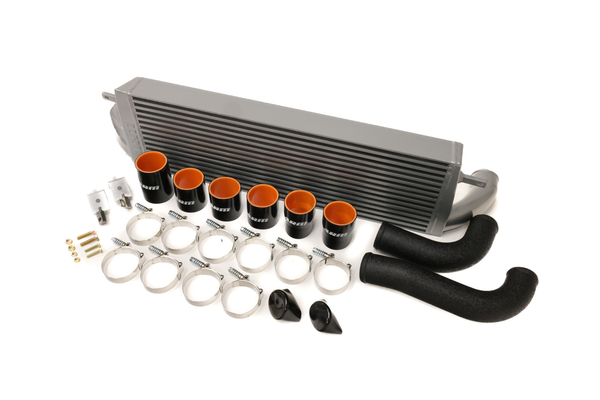
The ARM MK8 FMIC Kit positions the intercooler in front of the radiator stack, giving the Gen 4 EA888 maximum access to cool pre-radiator ambient air. It dramatically reduces intake air temperatures to keep your ECU out of timing-pull territory during back-to-back pulls and sustained high-boost driving. If your MK8 GTI or Golf R is running a tune, this is the thermal foundation your build needs.
The ARM MK8 FMIC installs 100% bolt-on, with no cutting, drilling, or fabrication required. It includes all platform-specific mounting hardware and piping needed to complete the installation. If you are running Stage 1 or Stage 2 power on the stock Continental turbo, this kit handles it.
| Spec | ARM MK8 FMIC Kit |
|---|---|
| Mount Position | True front-mount, pre-radiator |
| Compatible Engine | Gen 4 EA888 (MK8 GTI / Golf R) |
| Installation | 100% bolt-on, no cutting or drilling |
| Hardware Included | FMIC core, piping, mounting brackets, couplers, clamps |
The ARM MK8 Bi-Cooler Upgrade is not a standalone product. It is a piping kit that adds a second intercooler to your cooling path by allowing the ARM MK8 FMIC to run simultaneously with the stock-location intercooler (OEM or any upgraded unit that retains the factory charge pipe routing). Charge air passes through both intercoolers in sequence before reaching the intake manifold, giving it two separate opportunities to shed heat.

This creates a total cooling capacity that exceeds what either intercooler can achieve on its own, with maximum IAT headroom for high-demand builds. The dual-core setup maintains clean OEM-style fitment under the bumper.
The one trade-off to understand: running charge air through two cores and a longer piping path introduces a small amount of additional pressure drop versus the standalone FMIC. On the stock Continental turbo, this can partially offset the cooling benefit. This is why the Bi-Cooler setup is specifically recommended for MK8 builds that have moved to an upgraded turbocharger, where higher airflow rates and greater thermal load make the dual-core system the right tool. The additional pressure drop is easily absorbed by an upgraded turbo operating at elevated flow.
ARM Product
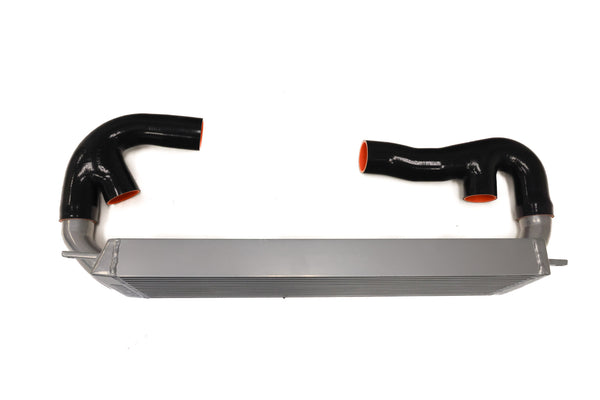
The ARM MK8 Bi-Cooler Upgrade pairs with the ARM MK8 FMIC Kit to create a complete dual-intercooler system for the Gen 4 EA888. It combines the FMIC's front-mount position with the stock-location intercooler running in series, significantly increasing total cooling volume while maintaining OEM-style fitment throughout. This is the maximum cooling configuration available for the MK8 platform, and it is built specifically for upgraded turbo builds where elevated boost and airflow demand dual-core thermal management.
| Detail | ARM MK8 Bi-Cooler |
|---|---|
| Setup Type | Dual intercooler (FMIC + stock-location in series) |
| Requires ARM MK8 FMIC Kit | Yes |
| Stock-Location Compatibility | OEM or upgraded (factory charge pipe routing required) |
| Recommended For | Upgraded turbo builds |
| Factor | Standalone FMIC | Bi-Cooler Setup |
|---|---|---|
| Cooling Capacity | Single core, front-mount efficiency advantage | Dual core, maximum total cooling volume |
| Pressure Drop | Minimal | Slightly higher (two cores + longer piping path) |
| Best Turbo Match | Stock Continental turbo, Stage 1/2 builds | Upgraded big-turbo builds |
| Install Complexity | 100% bolt-on, no cutting or drilling | Moderate additional piping work |
| OEM-Style Fitment | Yes | Yes, maintained throughout |
The MK8 Platform Advantage
ARM's own MK8 Golf R FBO build on the stock Continental turbo produced 457 wheel horsepower and 385 wheel torque on a 100% E85 tune, gains of 99whp and 100wtq over baseline. That result is only possible because the thermal management supporting the build, including an ARM MK8 FMIC Kit, keeps intake temperatures low enough for the ECU to let the tune run without pulling timing. The power ceiling on the MK8 platform is directly related to how well the charge-air cooling system works.
As with the MK7, the answer comes down to your turbo situation.
The ARM MK8 FMIC Kit is the right choice for your build. It delivers the thermal foundation your tune needs to run without ECU intervention, on any fuel type, in any weather. The 100% bolt-on installation means no modifications to your existing setup, and the Lifetime Warranty covers the product permanently. This is where the best value-to-performance ratio lives for the MK8 platform at stock-turbo power levels.
Shop the ARM MK8 FMIC KitThe Bi-Cooler setup is what your build needs. An upgraded turbocharger on the MK8 produces airflow and boost levels that push the thermal load beyond what a single FMIC can fully manage on sustained pulls. The ARM MK8 Bi-Cooler Upgrade connects the ARM FMIC and your stock-location intercooler in series, creating maximum dual-core cooling capacity with OEM-style fitment. The slight additional pressure drop from the dual-core path is absorbed by the upgraded turbo's higher flow capacity. Start with the ARM MK8 FMIC Kit and add the Bi-Cooler Upgrade to complete the system.
Shop the ARM MK8 Bi-Cooler UpgradeTechnically it is possible, but it is not recommended for stock-turbo builds. The additional pressure drop created by routing charge air through two intercooler cores in series can work against the stock Continental turbo's efficiency, potentially offsetting part of the cooling benefit. The standalone ARM MK8 FMIC Kit performs better on stock-turbo builds. Add the Bi-Cooler once an upgraded turbocharger is installed.
Yes, bumper removal is required to access the front of the radiator stack for any front-mount intercooler installation on the MK8. However, the ARM MK8 FMIC is 100% bolt-on once the bumper is removed, with no cutting, drilling, crash bar disassembly, or coolant work required. All mounting hardware and piping is included.
A stock-location intercooler upgrade replaces the OEM core with a larger unit in the same behind-the-bumper position, where it receives air that has already passed through the radiator. An FMIC relocates the core entirely in front of the radiator stack, giving it access to cooler pre-radiator ambient air. This positioning advantage is why a well-designed FMIC outperforms stock-location intercoolers that are physically larger in volume.
In most cases, no. The ARM MK8 FMIC is a hardware upgrade that gives your existing tune a better thermal environment to operate in. Most tunes will benefit immediately without any modification. If you are also upgrading your turbo or changing fuel type alongside the FMIC, a retune is recommended to take full advantage of the new thermal headroom.
The ARM MK8 FMIC Kit is engineered for the MK8 GTI and MK8 Golf R, both powered by the Gen 4 EA888 engine. For specific year and trim fitment confirmation, contact us directly or check the product page for the most current fitment guide.
Every ARM Motorsports product, including the MK8 FMIC Kit and MK8 Bi-Cooler Upgrade, is backed by a Lifetime Warranty issued automatically at purchase. It covers defects in craftsmanship and fitment and entitles you to a full replacement unit with no time limit.
ARM Motorsports
ARM MK8 intercooler kits ship free in the continental US, leave the same business day you order, and carry a Lifetime Warranty. Not sure which setup fits your build? Call us and we will tell you straight.
Call 213-434-7361 | Free US Shipping | Same-Day Shipping | Lifetime Warranty
The ARM Team
| Item | Price | Qty | Total | |
|---|---|---|---|---|
| Subtotal |
$0.00 |
|||
| Shipping | ||||
| Total | ||||
